Are Reddit Posts Indexed by Google? How to Check
Ethan Parker
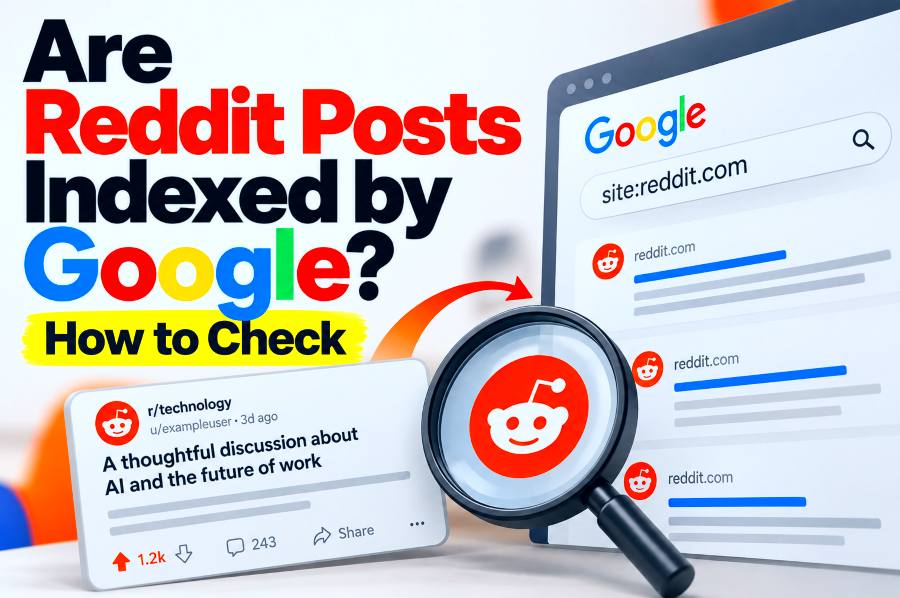
Yes, Google can index Reddit posts and show them in search results. Publishing a public Reddit discussion doesn't in any way guarantee that Google will index the URL or show it in response to a particular search. You can check whether a Reddit post appears in Google by searching the post's permalink, reviewing the results, and interpreting the evidence.
One key limitation: a post which doesn't appear in Google's site: search is not necessarily unindexed. Google's own documentation confirms that those results can be incomplete.
To make this more practical, we also reviewed 12 Reddit discussion URLs and a separate comment permalink on 19th October 2026. That initial audit picked up on several different URL and access issues (e.g., a post which had been removed by a moderator but which still returned a readable page). It didn't tell us which of the URLs Google indexed.
How to Check If Google Indexes a Reddit Post
You can actually investigate a Reddit post via Google's public search interface without having the Reddit site itself or access to the Reddit Google Search Console property.
The process starts with the precise permalink. A title search by itself is not good enough, as Google could return another thread with the same or very similar content.
Step 1: Copy the Reddit Post URL
Open the Reddit post and select Share > Copy Link or just copy the URL from your browser's address bar.
A standard Reddit discussion URL has this structure:
https://www.reddit.com/r/SEO/comments/1x6nul6/question_about_ai_crawlers_and_robotstxt/
This is a genuine discussion from our October 19 audit (entitled 'Question about AI crawlers and robots.txt').
The permalink has the subreddit name, the /comments/ path, a post ID, and a title slug. The post ID is particularly useful in separating discussions that have very similar titles.
Before checking Google, open the link in a private browser window to see if the discussion is actually public. Note any redirects or odd page states.
Opening a page successfully does not in any way confirm that Google has crawled or indexed it. It only confirms what was available to you at the time of your inspection.
Reddit comments also have separate permalinks. For example, our audit included this comment-specific address:
https://www.reddit.com/r/SEO/comments/1su6gep/comment/ohz25sg/
It was a comment-oriented view within its parent discussion. That in itself establishes a different URL format rather than a separate Google-indexed page.
If you're looking to check out a single comment, then use the comment's permalink rather than the parent thread URL.
Step 2: Search the Exact Reddit URL on Google
Open Google Search and enter a site: query to target the Reddit post.
For the real discussion above, an example query is:
site:reddit.com/r/SEO/comments/1x6nul6/
Google's official documentation for the site: operator says it can limit search results to a domain, a URL, or a URL prefix.
Using a particular Reddit post ID will of course restrict the search to that particular thread.
If Google returns the discussion, then compare that against the original Reddit URL. A matching result is useful positive evidence that Google can serve that discussion in Search.
If no result appears, try a distinctive phrase from the discussion title:
site:reddit.com "Question about AI crawlers and robots.txt"
A title search might help you find the discussion under a different address. Finding a matching title doesn't in itself prove that the particular permalink you submitted has been indexed.
These are example queries for a real Reddit URL (not the reported Google search results from our audit).
Step 3: Check Whether Google Returned the Same Discussion
A Google result with the same keywords isn't necessarily the Reddit post you were after.
For example, an SEO thread on indexing could be sitting alongside several others. You've got to check the URL of the result, the subreddit and the actual content.
Also bear in mind alternative URL formats. Google uses canonicalization to pick a single representative version when there are multiple URLs with essentially the same content.
Different addresses can of course end up pointing to the same Reddit thread. That doesn't mean that Google has a separate index entry for each version.
The distinction is particularly pertinent when looking at individual comment links. A comment that you can see in a discussion won't necessarily have its own independently indexed permalink.
For a useful audit, you should record the original URL, the returned URL (if any), the Google query, the date, and your own interpretation. If the result is ambiguous, then just record that it is ambiguous rather than trying to force a yes/no answer.
What Our 12-URL Reddit Audit Revealed
On 19th October 2026, we put together a small, deliberately selected set of Reddit URLs to see how various threads and permalinks behaved when pulled publicly.
The audit was of 12 r/SEO discussion URLs. These were split into three age groups: 4 'new' (0–7 days), 4 'medium' (8–30 days), and 4 'old' (>90 days). We pulled some dates from dated Reddit search results; others were unverified.
We also looked at one separate comment permalink.
The inspection recorded the following:
Observation | Audit finding |
Reddit discussion URLs | 12 |
Discussion pages displaying their content normally | 11 |
Discussion marked as moderator-removed | 1 |
Additional comment permalink examined | 1 |
Confirmed Google indexing verdicts | 0 |
These observations are of what the web search returned (i.e. what was available via web retrieval), not how many Reddit posts Google actually indexed.
A Moderator-Removed Post Still Returned a Page
One very useful example was an r/SEO thread on people asking why their brands weren't showing up in ChatGPT.
The Reddit page we retrieved had a moderator removal notice on it, though the title and some of the discussion context were still visible. The audit log also showed that there was an alternative /removed/ slug which resolved to the descriptive post URL.
This is a practical example of an important distinction: a removed Reddit post is not necessarily an inaccessible URL.
It by no means follows that Google has indexed the deleted page, has kept its former content, or has removed it from the index.
Those are separate questions which would require Google-specific evidence.
An Individual Comment Has Its Own URL
The audit also looked at a comment permalink from a thread on Google indexing issues.
The retrieval was a comment page for the parent thread.
This confirms that Reddit will expose comment-specific addresses which are worth looking at in isolation when the individual URL is of relevance.
It doesn't prove that Google indexes that permalink on its own, even if the parent thread does appear in search.
Audit limitation: there were no direct, local Google search results or completed BulkIndexCheckr batch results to capture during this initial look. The dataset therefore cannot establish a Reddit indexing rate, can't compare indexing by post age, and can't validate the accuracy of an indexing checker.
The value of this little audit is in the documented difference between URL accessibility, removal status, and URL type. It provides a reproducible baseline for the next indexing verification pass.
What do the Reddit indexing check results actually mean?
A fairly common mistake is to take "not found" to mean "not indexed".
Google is very clear that its site: operator doesn't necessarily return every indexed URL. Public search results can be a very useful source of evidence, but the simple absence of a result is not in itself a diagnosis of non-indexing.
Result | What it means | Recommended next step |
Exact Reddit discussion appears | Positive evidence of Google search visibility | Record the matching URL and check date |
Another Reddit URL appears | It may represent different content or an alternate address | Compare the post identifier and content |
No matching result appears | Index status remains uncertain | Verify the permalink and repeat the check when appropriate |
Discussion is removed or restricted | Current content availability has changed | Document the observed state separately |
It also helps to distinguish three processes.
Crawling is when Google's system goes out and fetches the page. Indexing is when it then analyses the page content to decide whether it's worth including in the index. Serving and ranking is when the page is then served up in response to a query and where it is positioned in the results.
Google details the various stages in its 'How Search Works' documentation. Not every page that is discovered or crawled will be indexed, and an indexed page is not guaranteed to appear in response to every query.
Google Search Console's URL Inspection tool can provide a bit more detail (crawl and canonical details in particular). The URL in question, of course, must belong to a Search Console property that the user has access to.
Publishing a post on Reddit doesn't give you Search Console ownership of reddit.com.
For third-party Reddit URLs, the practical approach is just to document the public search evidence and not to go around describing the uncertain results as Google's definitive state of internal indexing.
How to Check Multiple Reddit Posts With BulkIndexCheckr
Checking one Reddit post manually is fine. Checking dozens or hundreds is a different issue altogether in that you need a consistent query for each URL, a recorded result for each URL, and potentially a recheck at a later date.
BulkIndexCheckr provides a public bulk index checking interface for the purpose of checking multiple URLs. The home page currently describes manual URL entry, CSV/TXT imports, and third-party public URL checking.
The live interface shows a 50 check allowance; the platform itself promotes much larger authenticated batches of up to 50,000 URLs.
Using BulkIndexCheckr for Reddit URL Checks
For a collection of public Reddit discussions, the intended workflow is:
Collect the full Reddit permalinks. One discussion URL per line, please, and tidy up any accidental duplicates that may have crept in.
Open BulkIndexCheckr. You can use the live URL input or a supported CSV/TXT upload.
Run the index check. Select the interface's 'Check index status' action.
Review each returned result. Check any unexpected findings against manual Google searches and record the underlying check date.
Recheck the relevant URLs at a later stage. Keep the earlier results to tell the difference between a change in observation and an assumption as to precisely when Google indexed or removed the page.
For the initial audit referred to above, the 12 discussion permalinks are already in the form of a one-URL-per-line test list. The individual comment permalink will need to be checked separately as it's a different URL type.
BulkIndexCheckr's public description does indeed describe that workflow. Our October 19 audit didn't run the interactive batch check, so it doesn't establish Reddit-specific accuracy, returned statuses, or successful cross-platform compatibility.
The distinction matters for what the result actually means. A tool that uses public search signals can give you a useful 'indexed/not indexed' classification. That's not the same as having access to Google's internal URL Inspection record, though.
For bigger projects, our guide on checking indexed pages in bulk will show you how to organize your URL inventories and how to carry out the repeated checks.
A bulk indexing checker can be used to look at visibility. It doesn't in any way guarantee that Google will have indexed your site or give you the go-ahead to submit third-party Reddit URLs for indexing.
Why is my Reddit post not showing up on Google?
If a Reddit post isn't showing up in a Google search, then the first thing you need to do is establish whether the issue is one of indexing, one of search retrieval, or one of access to the original thread.
The post may not have been discovered or crawled at all. Google finds URLs via links and other discovery mechanisms and does not guarantee that every public URL will be crawled.
Google might have processed the content without actually indexing it as a separate page. Their indexing system looks at pages, and if it sees substantially the same content, it will pick one version as the canonical one.
The original discussion may have changed. Reddit posts can be removed, suppressed, or otherwise made less accessible. The October 19 audit is a perfect example of why a removal notice and a publicly accessible URL are two separate observations.
The post may be indexed but won't be returned for your query. If your search terms are very broad or very competitive, then other pages are likely to be ranking ahead of the discussion. Site: searches are also subject to retrieval limits.
Reddit also announced changes to their automated crawler controls in June 2024. The platform policies in place can affect how external crawlers can access Reddit, but the absence of a Google result in no way proves that a particular post has been blocked by robots.txt.
Google's expanded February 2024 partnership with Reddit should by no means be taken as an automatic indexing guarantee. Google made it clear that the agreement in no way altered its current practice of using publicly available, crawlable content for indexing.
There is no verified universal indexing timetable for Reddit posts. A discussion posted recently would not be classed as permanently unindexed just because a single search doesn't return it.
If you're looking at Reddit backlinks, bear in mind that the availability of the referring thread, whether Google indexes that thread, and the SEO value of the link are all separate issues. Our guide on getting backlinks indexed looks at the wider issue of the referring page.
Can you check Facebook posts, Facebook pages, X.com and Medium articles?
The same broad approach can be used to go and investigate other public social URLs. Just copy the exact permalink, check it's accessible, search for it, and then compare the result you get with the original.
However, each platform has different levels of visibility and different publication rules.
Platform | What to verify |
Facebook posts | Whether the individual post is public or restricted to a particular audience |
Facebook Pages | Whether the public Page itself or an individual Page post is being checked |
X.com posts | Whether the post is public or protected |
Medium articles | Whether the story is publicly published and eligible for external search indexing |
Facebook Pages can show up in external search engines, but that doesn't mean that every post made by a Page will end up with its own individual search result.
X's own documentation makes a distinction between public posts and protected posts (which are not intended to appear in third-party search engines).
Medium also has its own search distribution criteria. Their SEO documentation explains why publishing a story does not in itself mean the external search engines will pick it up.
These differences are important when you're doing a mixed social URL audit. You need to check public accessibility first and then interpret the indexing results in light of what the verification method is actually able to tell you.
BulkIndexCheckr advertises checks of public third-party URLs. Platform-specific support for Facebook, X.com, Medium, and Reddit comment permalinks should be verified via actual submissions rather than assumed from the general description.
What should you do after you've checked?
For one Reddit thread, begin with the public permalink and do a targeted Google search. A matching result is useful positive evidence; the absence of a result requires further investigation rather than being automatically interpreted as 'not indexed'.
For several posts, we'll maintain a dated URL inventory and use a bulk checking workflow to make the repeated observations much easier to manage.
The Oct 19th Reddit audit provides 12 actual discussion URLs that would pass a documented verification. The next piece of evidence would be the actual Google results and the BulkIndexCheckr outputs for those URLs (with the queries, timestamps, and any disputes).